Energy Homeostasis Context
Homeostatic Principles
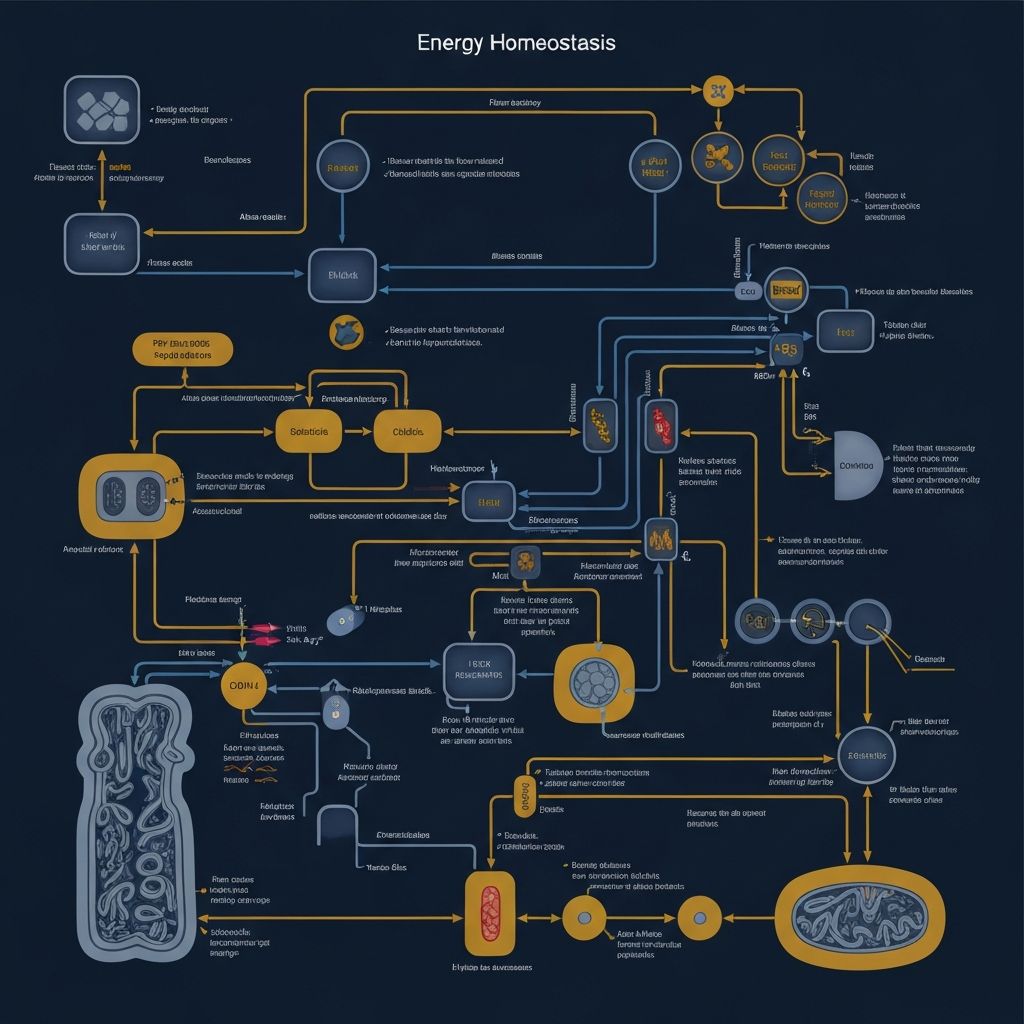
Energy homeostasis represents the body's tendency to maintain relative stability in energy storage and weight over extended time periods. This homeostatic principle reflects multiple physiological systems working in coordination to regulate energy status.
Regulatory Mechanisms
Multiple physiological mechanisms contribute to energy homeostasis including appetite regulation, metabolic rate adaptation, hormonal signalling, and behavioral factors. These mechanisms operate through feedback loops that detect energy status and trigger appropriate adjustments.
Research documents how these homeostatic systems can resist both energy surplus and deficit through metabolic and behavioral adaptations. However, these systems are not perfectly precise, and chronic environmental changes can shift the regulated body weight set point.
Short-Term vs Long-Term Regulation
Energy balance operates at multiple time scales. Short-term regulation through appetite hormones and metabolic signals responds to daily energy changes. Long-term regulation involves adaptive changes in metabolic rate and energy partitioning over weeks and months.
Population-level research demonstrates that weight tends toward relative stability over years in many individuals, reflecting long-term homeostatic regulation. However, significant variation exists in weight stability across individuals.
Metabolic Adaptation
The body adapts its metabolic rate and energy utilisation in response to prolonged energy surplus or deficit. During energy deficit, metabolic rate may decrease. During energy surplus, thermogenic processes may increase, though individual variation in adaptation is substantial.
These adaptive responses represent attempts by the body to minimise weight change and maintain homeostasis, though adaptation is incomplete and variable.
Appetite Regulation
Appetite and satiety are regulated through complex hormonal and neurological systems that detect energy status. Hormones including leptin, ghrelin, peptide YY, and others signal energy availability and influence eating behavior.
Individual variation in appetite signal sensitivity and responsiveness contributes to differences in weight regulation and eating patterns across individuals.
Environmental Interactions
Homeostatic regulation occurs within environmental context. Changes in food environment, activity opportunities, stress levels, and sleep patterns can shift the equilibrium around which the body regulates its energy state.
Population-level shifts in body weight reflect interactions between individual physiological systems and changing environmental factors.
Individual Differences
Significant individual differences exist in how effectively homeostatic mechanisms maintain energy stability and resist weight change. These differences reflect genetic factors, prior metabolic history, age, sex, and other physiological variables.
Research Perspective
Scientific research on energy homeostasis demonstrates that body weight regulation involves complex, multi-system interactions that operate imperfectly and vary across individuals. This complexity explains why population-level principles do not precisely predict individual outcomes.